
Why Annual ROC Compliance Matters
There are various annual requirements which are not understood by the Company Founders until the date falls like an arrow to shatters.Many of the Company Founders underestimate the requirements to be fulfilled in a Private Limited Company in India on an annual basis until the date comes like an arrow to a shatters. Compliance with the Registrar of Companies isn’t an option and it’s not something you can ‘neglect’ during a busy quarter or while your finance team has its hands in their own pockets. Each requirement is on a strict schedule, and if you do not meet the deadline for filing even one of the requirements, a daily penalty will be imposed. This checklist covers what a typical private limited company is required to submit on an annual basis and why it is more important than most company owners think that it is a scheduled process.
Annual ROC Compliance Requirements
1. Appointment of Statutory Auditor
A private limited company is required to appoint or ratify its statutory auditor within 30 days of the incorporation and at Annual General Meetings thereafter. This is done on Form ADT-1. It is often the basic compliance measure that is not taken first – it is done early in a company’s life when founders are not yet on a compliance schedule.
2. Holding the Annual General Meeting (AGM)
Any private limited company (after a few exempted exceptions like one person companies) must conduct Annual General Meeting within 6 months of the end of the financial year. This means that for most companies (which have a financial year that ends on 31 March) the AGM must take place before 30 September. Prior to lodging with the Registrar, the financial statements are approved by shareholders at the AGM.
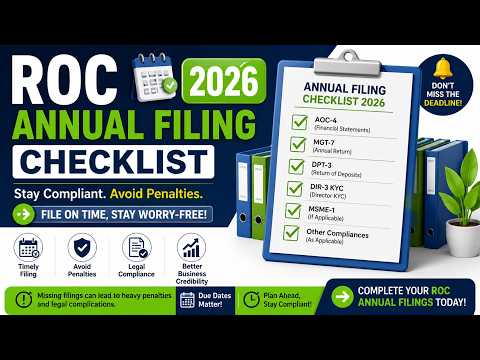
3. Filing Financial Statements – Form AOC-4
AOC-4 is the form used to file Financial Statements.AOC-4 is the required form for filing Financial Statements.
Adopting the financial statements at the Annual General Meeting (AGM) is followed by filing of Financial statements with ROC within 30 days of AGM in Form AOC-4. The balance sheet, profit and loss statement, cash flow statement (if applicable) and the auditor’s report are included in this filing. If a company has subsidiaries, they are also required to file a consolidated version if they comply with certain standards. It is important that this filing is correctly done and that the underlying books are as clean as possible, which is why the process of reconciliation should be started as early as possible before the AGM date (and not after).
4. Filing Annual Return – Form MGT-7 / MGT-7A
An Annual Return (Form MGT-7 or MGT-7A) is required to be filed.
Most companies are required to file the annual return in Form MGT-7, and in the case of small companies and one person companies, in Form MGT-7A. The document records details like shareholding pattern, changes in directors, particulars of the registered office and other structural information of the company at the time of the financial year. Often considered by mistake as a filing that is different from AOC-4, it is actually considered to be a separate filing, with different deadlines and a different purpose.
5. Director KYC – Form DIR-3 KYC
Each of the individual DIN holders must go through KYC, normally by 30 September each year. This is at director level and not at company level, but causes issues if DIN is deactivated while the company still needs to file documents as it contains director information that is linked to this DIN and cannot be processed easily.
6. Maintaining Statutory Registers
Ensuring the maintenance of statutory registers.Ensuring statutory registers are maintained.
In addition to the filings themselves, the private limited company should keep a set of statutory registers, such as the register of members, register of directors and key managerial personnel and register of charges (if any). As this register is not routinely filed with the ROC, it must remain accurate and up to date, and will be examined in the event of an audit or due diligence for fundraisers, or on the occasion of a regulatory inspection.
7. Event-Based Filings Throughout the Year
In addition to the required annual filings, there are a number of event-driven compliances that occur depending on the events which transpired inside the company throughout the year. These include changes in directors, alteration of share capital, registered office change, and charges on company assets (creating or changing). These are each individual in nature, and their timelines are generally not associated with the date of the financial year end, so they are not “one size fits all” and cannot be bundled together with the filings.
Why a Structured Compliance Calendar Matters
The above-mentioned individual requirements are not individually very onerous. For growing companies, the challenge of being compliant with ROC is particularly difficult because of the multiple moving parts and overlapping deadlines that require tracking at any given time, particularly after funding rounds, the addition of directors, or expansion in other areas. Don’t expect to get a flat penalty for missing an AOC-4 or MGT-7. This extra charge shall be at the rate of one day for each day of delay without discount at the discretion of the Registrar.
This is why it’s important for most well-run businesses to create a compliance calendar at the beginning of every financial year before they enter into any obligations, to identify all of the known dates and the progress of the calendar across the company’s incorporation date and its AGM plan, and its expected corporate changes. It creates a calendar like this, and makes compliance a predictable, manageable process.
How Badami & Kamath Can Help
The question is, how can Badami & Kamath help?But how can Badami & Kamath help?
Every company listed on the Registrar of Companies has to fill out a wide variety of paperwork every year, including annual returns, financial statements, and appointment of auditors, to remain compliant with the regulatory mandates of the ROC. At Badami & Kamath, we handle all the ROC compliance work of private limited companies in Bangalore including appointment of auditors, filing of financial statements, annual returns and other forms filed with ROC on a periodic basis. We base our process on keeping accurate records and ensuring that all statutory deadlines are closely tracked so that our clients are never surprised by data that they are required to file but are not aware of the deadline for.
If your business requires an assured partner to take care of the ROC properly and in time, connect with our team at Badami & Kamath for a consultation.